
Product Profile
US Army M2-2
Historic military backpack flamethrower that still serves as a useful benchmark when comparing modern long-range platforms.
Key stats
80 ft
8 sec
45 lbs
6.3 / 10
Technical Profile
- Gasoline, diesel, or thickened fuel mixtures
- 4 gal
- Nitrogen
- Magnesium ignition cartridges
- No
- Yes
- 🇺🇸 United States (WWII military production)
Use Cases
Aesthetics 5/5 • Build quality 4/5 • Support 1/5
Construction Notes
Material story and ownership feel
All metal
Metal tank group and wand hardware typical of wartime military construction
- Not rated
- No
Safety Notes
Things we would call out first
- Pressure valve reachable by the operator
- Quick-connect tank group design
- Separate ignition cartridge system
Service history: 1944–1978
The M2 series was developed by the US Army's Chemical Warfare Service starting in 1940–41, and the improved M2-2 became the standard American portable flamethrower of the Second World War. Roughly 25,000 M2-2 units were produced, and the platform served from the island campaigns of the Pacific through Korea and Vietnam before the US military retired flamethrowers from service in 1978.
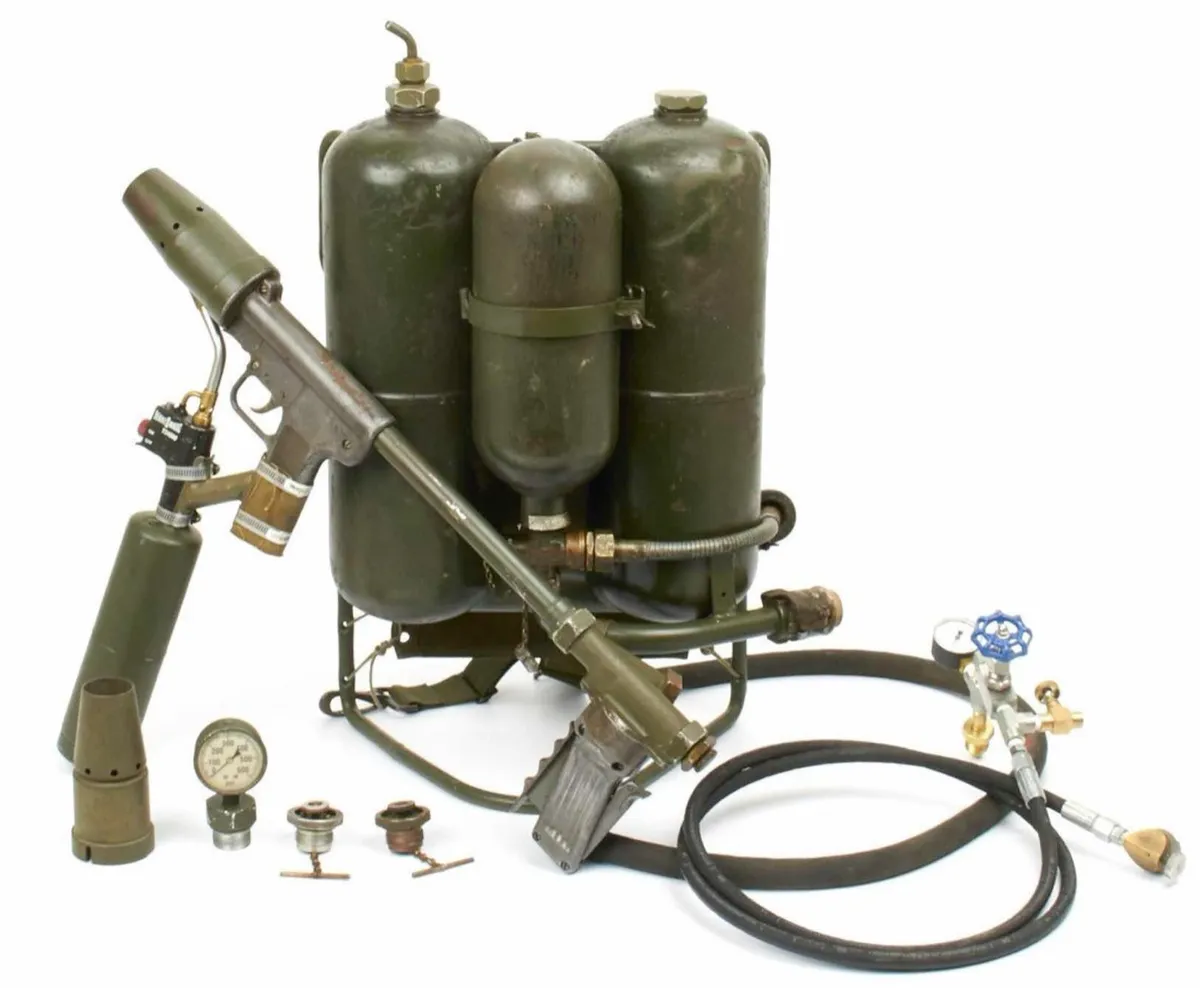
The design is a three-tank backpack: two fuel tanks flanking a central pressure sphere, feeding a wand with its own ignition group. At about 45 lbs fueled and roughly 80 feet of reach with thickened fuel, it remains the benchmark that modern units like the Throwflame XL18 are measured against.
Why collectors pay $20,000–$50,000
Operational examples on the secondhand collector market typically trade between $20,000 and $50,000. Three things drive the spread: condition and completeness (original tank group, wand, regulator, and igniter parts are hard to reassemble from scratch), whether the unit is operational or demilitarized, and provenance — documented theater history commands a premium.
Most surviving M2s are display pieces: deactivated examples with punctured tanks and removed internals sell for far less and are the form most militaria dealers actually stock. A genuinely operational, complete M2-2 is a rare event on the open market, which is exactly why the price band sits where it does.
Where M2 flamethrowers actually sell
There is no retail channel. Original units surface through militaria dealers such as International Military Antiques (typically deactivated display examples), through auction houses like Rock Island Auction, and through private collector-to-collector sales. Listings are scarce and move quickly; if you are hunting one, expect to watch the auction calendars for months rather than click a buy button.
Budget context for what modern money buys instead is in our flamethrower price guide — a new XL18 delivers more range than an M2-2 for about a tenth of an operational example's collector price.
Transfer legality
Flamethrowers are not classified as firearms federally, so no ATF paperwork applies to buying or selling an M2. State law is the thing to check: Maryland classifies flamethrowers as destructive devices requiring licensing, and California requires a State Fire Marshal permit for any device with a stream of 10 feet or more. The full state-by-state picture is on our safety & legality page.
M2 buyer questions
Is it legal to own an M2 flamethrower?
Federally yes — the ATF does not classify flamethrowers as firearms, so no federal license or paperwork applies. State rules still matter: Maryland requires destructive-device licensing and California requires a State Fire Marshal permit for devices with 10 feet or more of range.
How many M2-2 flamethrowers were made?
Approximately 25,000 M2-2 units were produced. The platform served with US forces from 1944 through 1978, spanning WWII, Korea, and Vietnam, and surviving complete examples are a small fraction of that production run.
What is an M2 flamethrower worth today?
Operational, complete examples typically trade for $20,000–$50,000 on the collector market depending on condition, completeness, and provenance. Deactivated display pieces with punctured tanks sell for considerably less.
Are the M2 flamethrowers for sale actually functional?
Most on the market are demilitarized display pieces — tanks punctured and internals removed. Genuinely operational units are rare, surface mainly at auction houses and private collector sales, and command the top of the price range.
Related Comparisons
Similar Models
Not-a-Flamethrower
Novelty propane torch included here as a cultural reference point, not as a current retail flamethrower option.
XL18
The flagship and the most powerful production flamethrower made: 110+ ft of reach and pure shock-and-awe output. The Formula One car of the category, and the unit film crews rent for movie fire scenes.
X15
The practical workhorse of the lineup: mid-to-high-tier output with a better utility profile than the XL18 for agricultural burns and property work, at roughly half the price.